Wildlife Diary for June 2016

Azure Damsels

Chimney Sweeper

Large Skipper

30th June, some poor weather is suppressing the insect activity and this is telling on the Swifts. They are normally high-level feeders, racing through the skies gathering insects. When the weather is poor they come lower down and this leads to accidents with cars and sometimes buildings, as they have the speed but often not the manoeuvrability. Swallows, however, are low-level insect catchers and often follow animals, vehicles and us as we inadvertently flush insects. My two Hebridians, Romulus and Remus refuse to get in the trailer and go on holiday with the rest of the CEP sheep. They now stand there staring at the gate. A Wren is singing full-belt on the gate post as if to scold them.

26th June, the good thing about looking up at a bird in the sky is you often see other birds in the process. I take the time to look at the now daily, but still amazing, Red Kite for a few seconds and notice 2 Hobby’s calling and swooping around it. I wonder if they have a nest nearby?

24th June, at CEP, working out with Kevin where the new ‘peoples pond’ is going to be and we see some big Dragonflies. The largest, a big blue-bodied male Emperor, is patrolling the open water on the existing pond with Black-tailed Skimmer and Broad-bodied Chaser around the edges. A male Southern Hawker appears. In the flower studded grassy areas, the first Meadow Browns and Ringlets join the Large Skippers amongst the Clover and Buttercup.

19th June, Buckby birder Ben sees a Weasel and Red-legged Partridge at Cotton End Park and sees 30 other bird species during his survey around the village. My wife sees a Jay.

15th June, escorting more guests to Hanglands for the Bee Orchids, and we hear a quiet but grating warble from inside a Hawthorn. It is a Sedge Warbler. We call the quieter song that some birds sometimes do, sub-song and think it may be the bird practising to itself prior to the main performance. This bird did eventually come out from the centre of the bush to the topmost twig and give the full rendition. Better late than never, there are 4 Speckled Woods on the wing.

Lesser Stag

Common Spotted Orchid

Holly Blue

12th June, A drowsy Lesser Stag Beetle wondered on the drive at home and even through the mandibles look a bit scary, I pick it up and deposit it in the log-pile out back. There is a degree of truth and humour in my son’s remark that it might have spent the last three days walking away from there in the first place. I find a big moth and have the joy of looking it up in a book. It is Scalloped Oak. Fab names Moths.

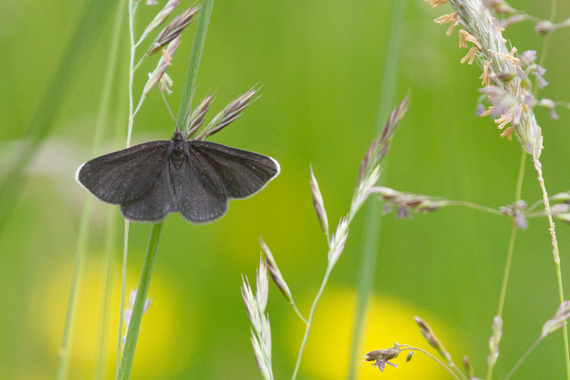
11th June, with the kind invitation from Trevor Moore of Costcutter, Sue and Chris Ebbage and myself are given access to private land off the West Haddon Road. Trevor and his family have created some wonderful habitats based on Trevor’s love for the Barn Owl. Sue and Chris were armed with their professional cameras and although the weather isn’t kind we still manage to see some good wildlife including Common Spotted Orchid and Chimney Sweeper Moth. Afterwards, I took them to Hanglands NR to look at the Bee Orchids.

10th June, there are Daddy long-legs or Crane Flies emerging at the moment and there is more than one species to look for. The commonest (Tipula Paludosa) is fairly dull and tends to emerge a bit later in the year but at the moment the small yellowish ones are the Spotted Crane-fly, and the massive ones with camouflage wings are Tipula Maxima.
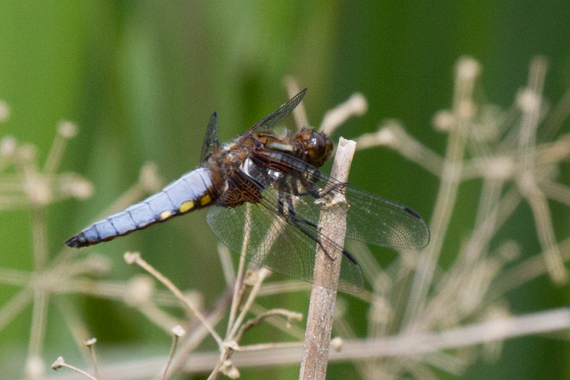
Male Broad bodied Chaser

Speckled Wood

Silver Ground Carpet

9th June, a warm morning at ponds of the Brington Road produces Dragonflies including Four-spotted and Broad-bodied Chasers, a Male Beautiful Demoiselle, and Azure, Red-eyed, Common Blue and Large Red Damselflies. Speckled Wood represented the Butterflies, and Silver Y, Brown China-mark, and Silver Ground Carpet, the Moths. A family of 4 Grey Heron and Coot were also about.

8th June, Red Kite is becoming daily and quite low over the village. Buzzards tend to come over the houses to get some thermal lift from heat retention in the roads and houses and disappear up and away, but the Kite is looking for food. Maraki reports a House Martin from the Holyoake crew being taken by a Sparrowhawk and suggest there are about 10 active nests which are more than last year. This contrasts with the loss of nests on The Banks and I wonder if The Banks crew has joined the Holyoake crew. Safety in numbers and all that.

6th June, one of the three immature Broad-bodied Chaser I saw last week has started to gain the blue colouring on the abdomen telling me it’s a male. He is fighting his brothers to establish a territory at the small pond on Hanglands. A Cormorant goes over towards Watford and the resident Lesser Whitethroat is still singing his heart out. Terry Laney reports Speckled Wood and 2 Painted Lady’s. The former is about a month late, and the latter a month early!


Wildlife Diary for May 2016

Red Kite

Female Blackcap

Chiffchaff

29th May, I walk past Evans Ponds on the footpath along the parish boundary with Watford and Haddon. I find a male Common Blue butterfly and 5 Burnet Companion moths, plus a Silver Y. There are lots of colourful Damselflies, like hovering matchsticks, Large Red, Azure Blue, White-legged, and Blue-tailed. There are Yellow Flag Iris and Ragged Robin in flower, and in the air above a Red Kite is following me, and a Lark is hard at it high in the big blue, oh the spring!

28th May, at Hanglands the Lesser Whitethroat and Blackcap are singing over the sound of my strimmer. I stop to refuel and in the distance, a Cuckoo utters two ‘cuckoos’. It is my first of the year and as far as I know the only one for the parish. I call Cuckoo enthusiast, Jenny Spokes, she arrives fairly quickly but we don’t hear it again. There are 3 Broad-bodied Chasers over the Nettle beds. They are huge insects and so perfectly adapted to hunting flight. During the evening the family joins me and we see 2 Hobbys together looking like they are house hunting. The Hobby is an ace catcher of Swallows, Martins and Swifts and nests in old Crows nests. We also see a ginger-red Fox his coat shining in the evening sun.

25th May, two residents of Parkfield and Syers Green Close report the Red Kite circling overhead. The smallish Hedgehog I saw on East Street last week didn’t last long and is squashed in the same place I saw it the other night. Sue Plant sees Red Kite and an Egret. Unbelievably, a white Egret these days could be a Little Egret or a Great White Egret, as both species are fairly regular in the county. The ‘Little’ is obviously smaller than a Grey Heron, the ‘Great White’ looks bigger. Red Admirals reported.

May Bug

Cuckoo Flower

Sweat Vanilla

24th May, Neil Chanter (our man on The Banks) relays that the House Martin colony on The Banks is no more. He has been on there for many years and says that in 2014 there were seven active nests but last year just three. This year they came and looked but did not stay. My wife finds a May Bug or Cockchafer, a now rare, large beetle, and gets a good photo. I just don’t see them anymore.

23rd May, Red Kite overload. There are 2 being seen quite low over the village which is upsetting the Jackdaws and Starlings that are busy breeding. I see a Hobby whilst watching a Kite, and Neil sees a Hobby as well. Holly Blues are in my garden and I see a female lay her eggs on the budding flowers. To my dismay a Blue Tit comes along five minutes later and seems to be picking at the very same spot.

21st May, Alan Webb finds a Grey Wagtails nest whilst on a WBLA work party on the Canal. My family use it as an excuse for a walk and enjoy seeing Grey Heron, Moorhen and Mallard with fluffy young, and the Wagtails. The mature gardens along the sides hold at least 2 singing Goldcrest’s plus Chiffchaffs and Blackcaps.

Sing For Spring

Marsh Marigold

Robin

20th May, A Mute Swan flies over as do 2 Cormorant. Red Kites are daily and Buzzard and Sparrowhawk barely get a mention. I see a live smallish Hedgehog on East Street during the evening and keep my fingers crossed.

17th May, I have been with a lady teaching her bird song and have realized that 40 odd years of knowledge cannot be passed on that easily. She shows me an app’ which is a real asset, and makes it easier for me to give out ‘homework’. I use it to sort out the annual bird song issue; is that a Blackcap or is it a Garden Warbler? It is a well-known birding dilemma that even the good birders struggle with, but the app’ is very helpful when the memory lets you down.

15th May, my neighbours draw my attention to 2 Red Kites low over the village, and other reports of them come in. At CEP we find a Robins nest with 5 chicks and a Pheasant on 12 eggs. There has been a hatching of St Marks Fly, again a couple of weeks later than last year. There is a part circle of St Georges Mushroom, you could argue they are late as well. Bernie, Lee, Cassie, David, Daniel, Jo and others see the Kites.

8th May, Nick Hudson sends a great photo of the large house spider Tegenaria Gigantea, and Ben Reeve sees 30 bird species, including Moorhen with chicks at CEP. At Hanglands NR, the first of the dragons/damsels are about in the form of 2 immature Large Red Damsels. There are one or two Bee Fly’s hovering in front of anything that looks like it might be the entrance of a bees nest, flicking their abdomens as they deposit eggs. The young are parasites of mining bees.

7th May, I see young Blackbirds and a young Robin along Lodge Lane. Other than size, they look rather similar at this age which belays their belonging to the same bird family The Thrushes. This family also includes Redstarts, Wheatears, Nightingale, The Chats, and of course the true Thrushes like Mistle, and Song. I pop into CEP and find young Mistle Thrushes, a Great-spotted Woodpecker, singing Blackcap and a brief glimpse of a Spotted Flycatcher. These are rare now, 20 years ago there were several pairs annually about the village. A splash of soft pink tells me that at last the Ladies Sock/Cuckoo Flower is in bloom. These flowers must be two weeks later than last year. Terry Laney reports Bee Fly, and Raven, and whilst looking up sees a large raptor alongside a Common Buzzard which he thinks is a Honey Buzzard. These birds are a rare British breeding bird and live on the larvae of wasps and bees, in the forested parts of the UK.

Mallard

Smooth Newt

New Helper

6th May, a warm day and the House Martins, and Swifts are over the village making a stand for summer. I see a Little Owl and a Hare off the Brington Road, and there are several of each of Holly Blue, Orange-tip, Green-veined White, Small Tortoiseshell and Peacock about.

5th may, Beth York sees Orange-tip at Watts Way, and a Peacock is seen in South Close. There are many parties of Mallard ducklings about the village and a nervous female is escorting her 14 down East Street to the delight/dismay of the morning commute. Yesterday’s one Swift turns into 13 and they scream information above The Library. Adam reports a Stoat and a Red Kite.

4th May, 7 house martins from the Holyoake crew are about over The Leys, and a Swift appears amongst them. Thomas reports 3 Bats from the garden.

2nd May I am aware that one of the regular passage migrants is missing from my list and that the passage time period is nearly up. I have been making an effort to go to where I might expect to see Redstart but have failed so far. With maintenance of the ponds at Hanglands NR on my mind, I spend a couple of hours carefully clearing some dead bulrush and on my way back, having to open a couple of field gates, look up and see the satisfying flash of brick-red telling me a Redstart is a fly, catching. The female sits for me while I grab the binoculars and then after a minute slips away.

Wildlife Diary for April 2016

Lapwing

Kestrel

Green Woodpecker

30th April, the North wind has stopped and the game is on. The First Yellow Wagtail comes over Lodge Lane, then ten minutes later another. I change tack and head for the big fields towards Haddon. I break out the artillery, and methodically use the telescope to scan the fence tops and hedges, and am eventually rewarded by distant shapes that ‘look good’. I am in my element as I move through the countryside, it is like hunting but I just want to see and identify. The skill is not be seen or disturb what you are looking at, to get the sun behind you, to be patient and move in a certain way, to position, to focus. A fine male Whinchat, followed by a female Wheater. The whole of this month I’ve been searching, and now the reward. Passage migrants are special. All the way from Africa, heading to Northern lands, the chances of connecting with them is quite low, and as I sit in a small gap in this hedge miles from anywhere I can’t help but smile. 2 Hares, 9 Skylarks, 2 Grey Partridge, 1 Lapwing and 3 Yellow Wagtails make the day.

28th April, the Wood Pigeon squab leaves the nest on the porch with an explosion of twigs, feathers and poo. It sits under my truck willing to be squashed but I chivvy it out and assist it into the air with my right boot. Hares reported from 3 places over the last week. We see only 1 House Martin over Murcott, and the cold wind is still holding things up.

26th April, morning after morning of frost and cold winds are holding back many species. I find the buds of a Ladies Smock a good week away from opening. At Cotton End Park the peace is wonderful as the Community Flock plus lambs have now gone on holiday. The paddocks now have Mistle and Song Thrushes, Blackbird, Robin, Moorhen, Stock Dove, and Jackdaw generally feeding. The car-park has twenty odd Greenfinches and Chiffchaffs and Blackcap sing from the greenery. A pair of Kestrel is ever present.

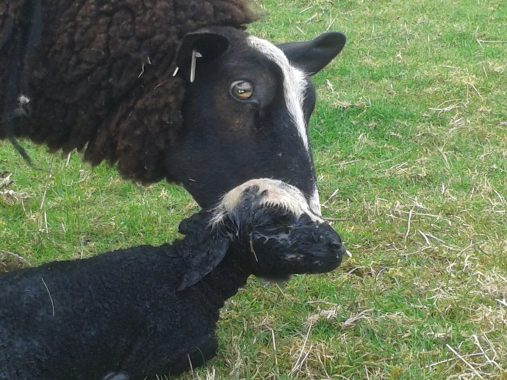
24th April, early morning, pre-work, migrant hunting, walks are now regular. 5 Lesser and 2 Common Whitethroats noted. Later David Walden and I see the season’s first Hobby over East Street. The standard dead Hedgehog is a sad sight. Survives a long winter’s hibernation, gets up, goes for breakfast, gets run over. We find a dead Muntjac in the field. It too has the injuries suggesting an RTI. To match that the Badgers are throwing themselves under cars. It’s all to do with too much speed and/or not caring anyway. Lambing duties, work and the park are all consuming. My old Herdwick slips a still-born, but the Swart gives a pair of fine long-legged sprites.

20th April, a bit of warm produces the first Green-veined White butterfly plus Small Tortoiseshell and Brimstone. A House Martin appears in the sky briefly, and I see a pair of Linnets, a Jay and 3 Tree Sparrows, on a long walk. Neil sees Nuthatch, and Jenny reports Bats, and a Meadow Pipit goes over. I see 5 species of Bumblebee over the course of the week.

My Old Herdwick

Male House Sparrow

The Warm Up

16th April, The trouble with declaring Spring is that it then backs out of the deal. In a raw wind, I give myself time to walk to Oak Tree Farm, 2 Swallows pass by and I hear a new, arrival, a Lesser Whitethroat singing from Vanderplanks Covert. It is cold again and I amble down Lodge Lane wondering why there are no more migrant bird, s about. It then snows on me and I give up looking. Jim Jelley reports Little Egret and Swallow. Richard Brennecker reports Willow Warbler and Red Kite.

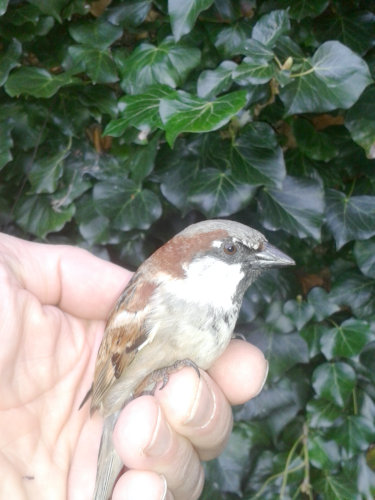
13th April, I am in the office with the doors open to the front of the house when I hear the House Sparrows start to argue. The sound increases and then I hear 2 dull thuds. I get up and look outside to see if they have hit the windows but no. Then I go back into the house and there on the kitchen sink sit a pair of Sparrows. Being stunned they let me pick them up and I return to the front and sit them on the wall for a moment of recovery. 2 Swallows and a Brimstone go over the garden and later I see the first Willow Warbler of the year. David Green sees Bats around Ashmore/High Stack. I mentally declare Spring.

10th April, I am amazed to see a dozen or more Greenfinches around Cotton End. I have also seen some down at St Lawrence’s. Maybe they starting to build numbers again. Near the Old Coopers on Lodge Lane, a/the last lone Fieldfare is feeding in the sheep paddock. Common Carder and Red-tailed Bumblebees are about the gardens, and Thomas and his mates see the Owl hunting in the field near the Church. Brian Laney reports Scarlet Tiger moth caterpillars on Comfrey at Market Place.

Half Hour Well Spent

Wren

road traffic incident

9th April, I am opening the Park and hear an odd song, I grab the bins’ and see a grey/brown Chiffchaff feeding with 2 ‘normal’ Chiffchaffs in the massive Sycamore at Heath View. It is acting rather oddly moving rapidly and uttering bits of a Chiffchaff-like song but with other complex aspects. I eventually get good views of the bird and think it is an eastern or maybe a ‘Siberian’ form. These forms seem to get into the UK during winter, but it’s still a bit of a shock to see one in Buckby. I go home and access the ‘net finding a positively identified ‘Sibe’ Chiffchaff singing similar phases to my bird.

I text the county bird recorder and he suggests I use my phone to get a recording of the song, but when I get back to the park the birds are quieter and I don’t get any conclusive song. Regardless of the song, I am still happy, based on plumage alone, that the bird was probably a ‘Sibe’ Chiffchaff.

7th April, I wake up and look out the bedroom window and see 2 male Blackcaps having a drink at my small pond. Neil Chanter reports a grey Tawny Owl from the allotments, and Mandy, Keith and others see the Short-eared Owl again.

5th April, the fabulous Bridge House Farm Lake has 4 Swallows, 2 Grey Wagtails and 2 Pied Wagtails. On the water, there are 14 Teal, 2 Gadwall, 6 Mallard and 2 Moorhen. Pete Seymour reports Red Kites and Ravens daily plus hopefully a breeding pair of Lapwing. Donna sees 2 Stoats around the Sheep shed at CEP, and Alison finds a live Bee Fly.

4th April, Terry Laney reports Chiffchaff, and there are 2 at CEP on morning check-round. Alan Webb has Redpoll on his feeders, and a Cormorant is seen over the village.